Quick Answer
ACOG says 600 mcg DFE of folate daily during pregnancy, with at least 400 mcg from a prenatal vitamin — that part is settled. What is not settled in any clean Google snippet: folate (the food version) and folic acid (the synthetic version) absorb differently, the MTHFR gene quietly changes how your body processes folic acid, and most US prenatals under-deliver natural folate even when the label looks generous. I sorted through 30 tabs of research at week 12 because I could not get a clear answer from a single source. The full conversion table for folate rich foods pregnancy diets, the MTHFR section for moms who were never tested, and the 15-food source list with USDA DFE values are below — and the dosage table covers both US ACOG and UK NHS pregnancy guidance with sources.

Folate vs Folic Acid: They Are Not the Same Word in Different Languages
I am going to be honest — I used these interchangeably for the first eight weeks of pregnancy. Then I read the NIH Office of Dietary Supplements folate fact sheet at 1am and realized I had been mixing up three different things. The terminology matters more than I expected, because the label on your prenatal bottle and the label on your fortified cereal box are using different versions of the same vitamin with different absorption rates.
The short version
- Folate is the umbrella name for vitamin B9, including the natural form in food (mainly polyglutamate folate) and the active form your body actually uses (5-methyltetrahydrofolate, or 5-MTHF).
- Folic acid is the synthetic, fully oxidized form added to prenatal vitamins, fortified breads, and most US cereals. It is not biologically active until your liver converts it.
- 5-MTHF (methylfolate) is the form that actually crosses into your cells and into the developing neural tube. Some prenatals use this directly instead of folic acid.
Why "mcg DFE" is on every label
The unit is micrograms of Dietary Folate Equivalents, and it exists because your body absorbs folic acid roughly 1.7x more efficiently than the folate that comes naturally in food. Per the NIH ODS, about 85% of folic acid is bioavailable when taken with food, while only about 50% of natural food folate is absorbed. So when a fortified cereal label says "667 mcg DFE (400 mcg folic acid)," it is doing the conversion math for you behind the scenes. A cup of cooked lentils with 358 mcg of natural folate is 358 mcg DFE — no multiplier, because food folate is the baseline. Once I knew this, comparing two prenatal labels stopped feeling like reading a foreign language.
How Much Folate You Actually Need (And When)
The dose recommendations are surprisingly consistent across the major guidelines, even though the framing differs between US (total daily intake) and UK (supplement amount). Here is the side-by-side I wish someone had handed me at week 5 instead of leaving me to puzzle out why ACOG and NHS were saying different numbers that were actually the same number.
| Life Stage | Daily Target (mcg DFE) | Source | Notes |
|---|---|---|---|
| Trying to conceive (US) | 400 mcg folic acid | CDC | Start at least 1 month before conception |
| Trying to conceive (UK) | 400 mcg folic acid | NHS | Until week 12; identical to US baseline |
| Pregnant, weeks 1-12 | 600 mcg DFE total | ACOG CO 762 | At least 400 mcg from prenatal, rest from food |
| Pregnant, weeks 13-40 | 600 mcg DFE total | ACOG / NIH ODS | Most US prenatals continue 400-800 mcg |
| Previous NTD pregnancy | 4,000 mcg (4 mg) | ACOG | 3 months pre-conception through first trimester — prescription only |
| UK high-risk (BMI 30+, diabetes, antiepileptics) | 5,000 mcg (5 mg) | NHS | GP prescription, not over-the-counter |
| Breastfeeding | 500 mcg DFE | NIH ODS | Drops back down after delivery |
The CDC estimates that universal preconception folic acid intake could prevent 50-70% of neural tube defects. That number is from the 1990s mandatory fortification data and it still holds — this is the most evidence-backed single nutrient intervention in prenatal care. The neural tube closes by about week 6 post-conception (week 8 by standard counting), often before a positive test, which is why the CDC recommendation is for all women capable of becoming pregnant, not just those actively trying.
The MTHFR Question (For Moms Who Were Never Tested)
This is the part Reddit will not stop arguing about. So here's the thing: MTHFR is a real enzyme, the gene variants are real, and the supplement-industry panic around it is mostly overblown — but not entirely. The MTHFR enzyme converts dietary folate (and folic acid, after your liver processes it) into 5-MTHF, the active form your cells use. Two common gene variants — C677T and A1298C — reduce that enzyme's efficiency. About 25% of people of European/Asian descent and 10-15% of African descent carry at least one C677T variant, per PubMed meta-analysis data. So this is not rare, but most carriers have no idea, because routine prenatal panels do not screen for it.
Honest answer based on the research: it probably matters less than the internet says. The 2015 randomized controlled trial in recurrent miscarriage compared 5-MTHF directly against folic acid in women with MTHFR variants — both groups had similar pregnancy outcomes. Serum folate rose faster on 5-MTHF, but actual outcomes were equivalent. The fix when in doubt is simple: hit your target intake. If you have a known MTHFR variant or recurrent loss history, a prenatal using 5-MTHF (methylfolate) is a reasonable choice — but the more important variable is total intake, not which chemical form.
ACOG and the American College of Medical Genetics do not recommend routine MTHFR screening in pregnancy. It is not part of standard prenatal panels, your insurance probably will not cover it, and a positive result rarely changes management for an otherwise typical pregnancy. If you want it, ask your OB. For everyone else, switching to a methylfolate prenatal "just in case" is cheaper and gives you the same practical outcome.
Why Your Prenatal Probably Misses the Mark
I went through three prenatals before I bothered to actually compare the folate forms on the labels. Most marketing claims are vague on purpose — "high potency folate" can mean any of three different chemical forms, and the actual ingredient line is usually in 6-point type on the back of the bottle. Here is what to scan for in the supplement aisle:
- "Folic acid" only: Cheapest, most common, best-studied form. Fine for the roughly 75% of people without significant MTHFR variants. This is what 1990s fortification data is built on.
- "L-methylfolate" / "5-MTHF" / "Quatrefolic" / "Metafolin": The active form. Bypasses the MTHFR conversion step entirely. More expensive. Brands that use it: Ritual, Needed, FullWell, some Garden of Life lines, and several smaller direct-to-consumer brands.
- Mixed forms: Some prenatals combine folic acid + methylfolate to cover both bases. Reasonable middle ground if you cannot decide.
- "Folate" listed with no specification: Usually means folic acid in practice. Read the actual ingredient line, not the front-of-bottle marketing copy.
The other gap most prenatals quietly leave: they hit the 400-800 mcg supplement floor, but they do not magically replace whole food folate. The natural form comes packaged with fiber, B12 cofactors, and choline — which is the nutrient I went down a separate rabbit hole on (covered in our choline trimester guide). The prenatal is the safety net for the days when food intake collapses, not the whole strategy.
15 Folate-Rich Foods, Ranked by What Actually Fits a Pregnancy Diet
I excluded anything that triggers most early-pregnancy aversions (I am looking at you, raw liver) and pulled the numbers from the USDA FoodData Central baseline. Values are per serving and represent natural food folate in mcg DFE — the food folate baseline, no synthetic multiplier applied. If you came here looking for folate rich foods pregnancy lists that actually fit a real plate, this table is the part to bookmark.
| Food | Serving | Folate (mcg DFE) | % of 600 mcg target | Trimester notes |
|---|---|---|---|---|
| Beef liver, cooked | 3 oz (85 g) | 212 | 35% | Limit to 1 serving/week — high vitamin A |
| Lentils, cooked | 1 cup (198 g) | 358 | 60% | All trimesters; high fiber bonus |
| Edamame, cooked | 1 cup | 482 | 80% | All trimesters; protein bonus |
| Asparagus, cooked | 1/2 cup (90 g) | 134 | 22% | All trimesters |
| Spinach, boiled | 1/2 cup | 131 | 22% | All trimesters; iron bonus |
| Spinach, raw | 1 cup | 58 | 10% | Wash thoroughly |
| Black-eyed peas, cooked | 1 cup | 358 | 60% | All trimesters |
| Avocado | 1/2 medium | 59 | 10% | All trimesters; good fats |
| Broccoli, cooked | 1 cup | 104 | 17% | All trimesters |
| Brussels sprouts, cooked | 1 cup | 94 | 16% | All trimesters |
| Romaine lettuce | 1 cup | 64 | 11% | Wash thoroughly; raw caution if listeria-anxious |
| Orange (whole) | 1 medium | 40 | 7% | Vitamin C boost for iron absorption |
| Egg (whole, large) | 1 | 22 | 4% | Plus 147 mg choline in yolk |
| Fortified cereal | 1 serving | 400-667 mcg DFE | 67-110% | Counts as folic acid, not natural folate |
| Enriched pasta, cooked | 1 cup | 102 mcg DFE | 17% | Counts as folic acid |
Fortified cereal is the cheat code. Half a cup of a fortified breakfast cereal plus a 400 mcg prenatal puts you over the 600 mcg DFE line before noon. If aversions are killing your appetite (covered in our first trimester survival guide), this is the lowest-effort win in the rotation.
Building a Real-Life Folate Day (Week 13 Example)
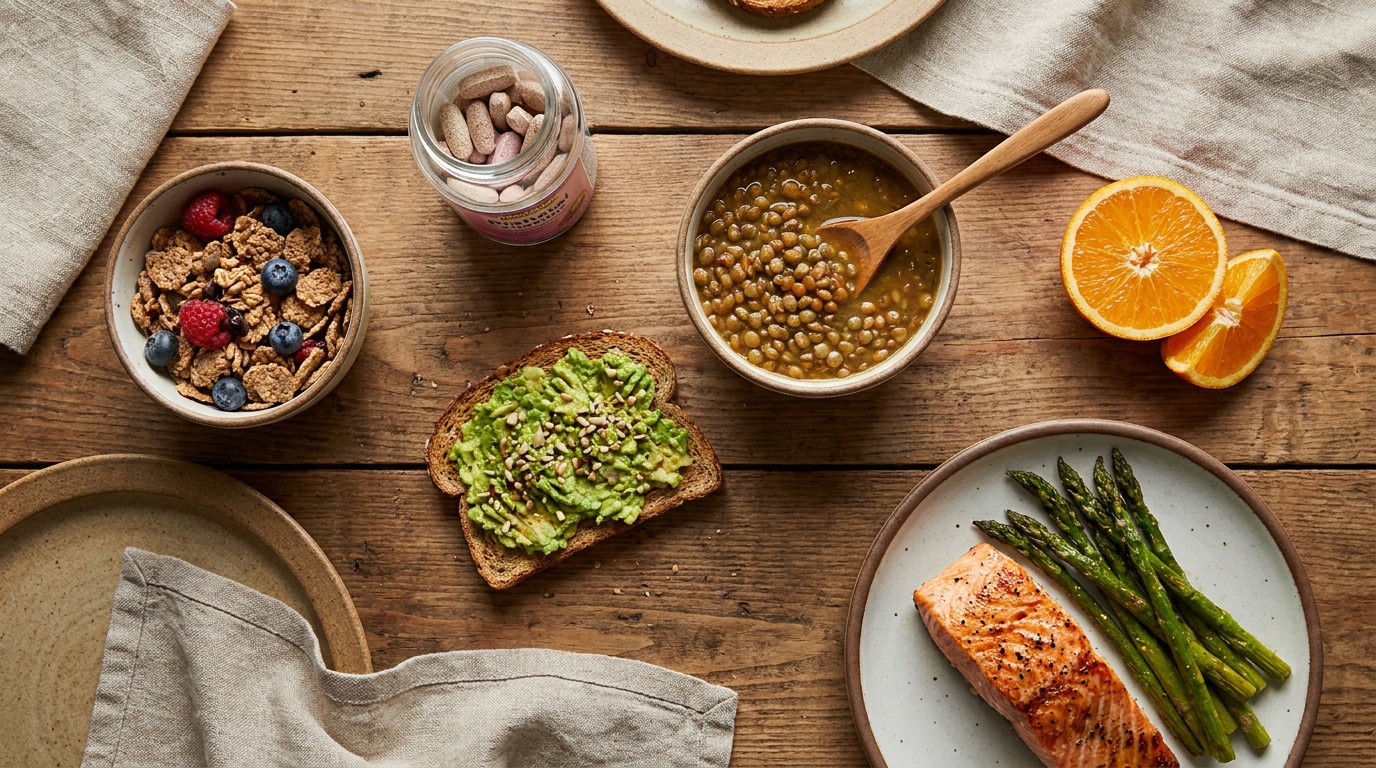
Here is what an actual 600+ mcg DFE day looked like for me this week — I am at week 13 and the food aversions are finally easing, so I had options I did not have at week 9. Your mileage will vary based on what your stomach is letting you near today.
- Breakfast: 1 cup fortified cereal (400 mcg DFE) + 1/2 orange (20 mcg). Running total: 420 mcg.
- Prenatal vitamin: 400 mcg DFE methylfolate. Running total: 820 mcg.
- Lunch: Lentil soup (1 cup, 358 mcg) + romaine salad (64 mcg). Running total: 1,242 mcg.
- Snack: Half avocado on toast (59 mcg). Running total: 1,301 mcg.
- Dinner: Salmon + roasted asparagus (1/2 cup, 134 mcg). Running total: 1,435 mcg.
Upper limit caveat: the tolerable upper intake for folic acid (synthetic) is 1,000 mcg per day for adults per NIH ODS — that ceiling only applies to the synthetic form because of concerns about masking B12 deficiency. Natural food folate has no upper limit. The 1,435 above includes maybe 800 mcg from synthetic sources and the rest from food, so technically right at the synthetic ceiling. For most days I aim for 400-600 from supplement/fortified + the rest from food. If your pregnancy is at week 10 or earlier and you are still in survival mode, our week 10 food guide has aversion-friendly swaps.
Frequently Asked Questions
Is it too late to start folic acid if I just found out I am pregnant?
Start today. The neural tube closes by week 6 of pregnancy (about 4 weeks post-conception), so the highest-impact window is preconception through week 6. After that, folate still matters for ongoing brain, spine, and blood cell development. ACOG's recommendation continues through pregnancy at 600 mcg DFE per day. Talk to your OB if you missed the early window; do not skip the prenatal now.
Is methylfolate (5-MTHF) better than folic acid for everyone?
Not based on current evidence. The 2015 RCT in women with recurrent miscarriage found no outcome difference between 5-MTHF and folic acid even in MTHFR variant carriers. Methylfolate may be a smart choice if you have known MTHFR C677T homozygous variants, recurrent loss history, or your OB recommended it — but for most pregnancies, folic acid works and is cheaper. The form matters less than hitting the daily total.
Should I get a MTHFR genetic test before or during pregnancy?
ACOG and ACMG do not recommend routine MTHFR testing — it is not part of standard prenatal screening, and a positive result rarely changes management. Consider asking your OB if you have a personal or family history of recurrent miscarriage, a prior NTD pregnancy, or known thrombophilia. For everyone else, switching to a methylfolate prenatal gives the same practical outcome at lower cost than a genetic test.
Does the UK 400 mcg recommendation conflict with the US 600 mcg target?
Not really. The UK NHS 400 mcg figure is the supplement amount until week 12, while the US 600 mcg is the total daily intake target including food and supplement together. The supplement floor is identical (400 mcg). If you live in the UK and eat a typical folate-containing diet, you are likely also hitting the 600 mcg total — just framed differently in the guidance documents.