What is a healthy pregnancy diet plan, at a glance?
A healthy pregnancy diet plan is your normal balanced plate — vegetables and fruit, a protein, a whole-grain carb, and a dairy or fortified source — plus a daily prenatal that covers folic acid and iron, which the NHS says food alone rarely delivers. No single "miracle" food is required. The full food-group portions, nutrient targets, and a copy-and-use day are below.
I built this the way I wish someone had built it for me at 3am in week 7, staring at a fridge that suddenly smelled wrong. It only really works when you read the pieces together — the food groups feed the nutrients, the nutrients shift by trimester, and the sample day shows you what that looks like on an actual plate.
How many servings of each food group do I need per day?
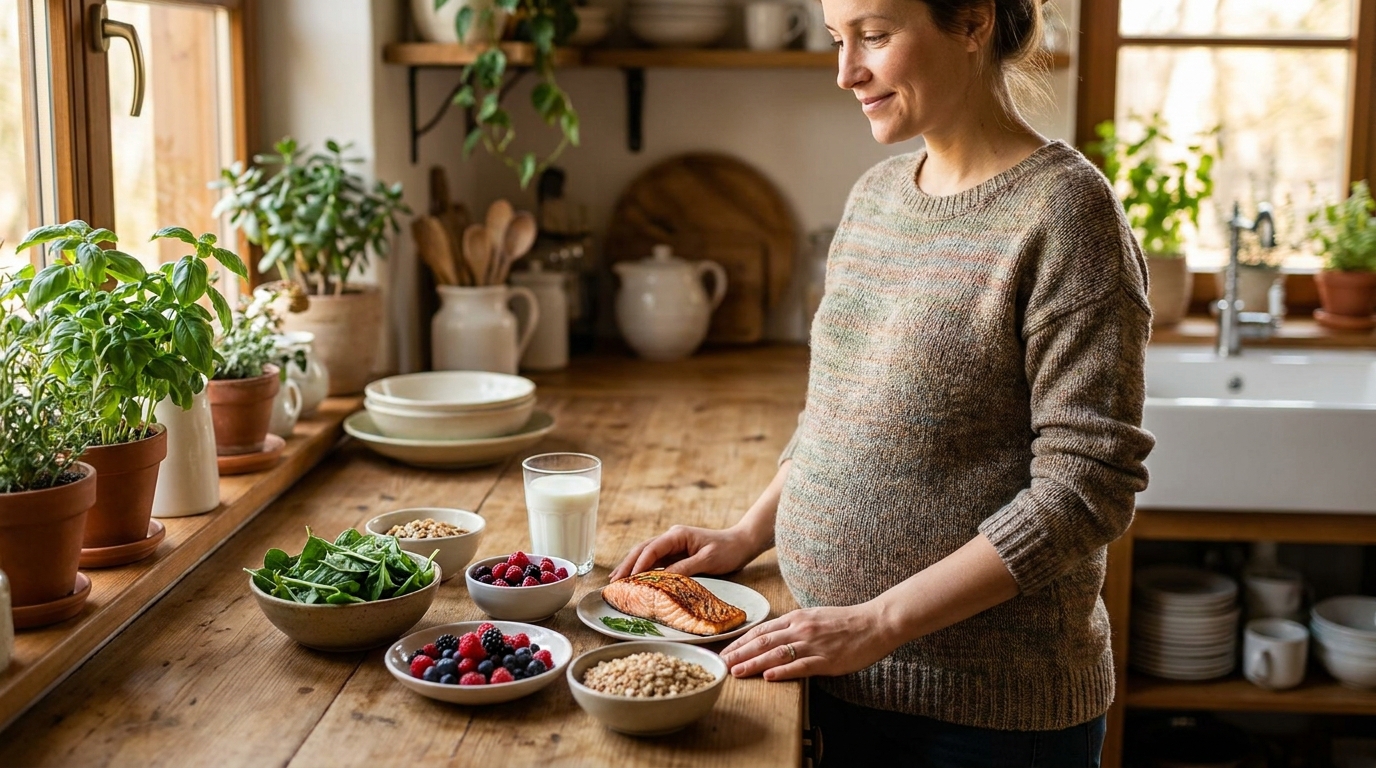
Across a day, most pregnant people are steered toward roughly 5 portions of vegetables and fruit, 3 servings of starchy whole grains, 2–3 protein servings, and 2–3 dairy or fortified-alternative servings, per NHS healthy-eating guidance. The exact counts flex with your appetite and trimester — the point is variety across the week, not a perfect scorecard every day.
According to NHS advice, starchy foods should make up a bit over a third of what you eat, and vegetables and fruit another third. In my first trimester that math was aspirational — some days a plain bagel was the whole win — but the framework gave me something to drift back toward once the nausea eased around week 14.
| Food group | Servings/day | One serving looks like | Key nutrient it carries | Source |
|---|---|---|---|---|
| Vegetables & fruit | ~5 portions | 80g = 1 apple or 3 heaped tbsp veg | Folate, fiber, vitamin C | NHS |
| Starchy whole grains | ~3–4 servings | 1 slice bread or 3 tbsp cooked oats | ~3g fiber/serving, B vitamins | NHS |
| Protein (meat, fish, eggs, beans) | 2–3 servings | 1 palm-size fillet or 150g beans | Protein, iron, choline | ACOG |
| Dairy / fortified alternatives | 2–3 servings | 1 glass milk (~300mg calcium) | ~1000mg calcium/day target (NIH) | NIH ODS |
| Oily fish | 1–2/week (max 2) | 140g cooked salmon/sardines | Omega-3 (DHA) | NHS |
If you want the trimester-specific spin on portions, my second-trimester eating guide breaks down what shifts once your appetite comes back.
What nutrients should a pregnancy diet always include?
Five nutrients do the heavy lifting: folic acid, iron, calcium, vitamin D, and omega-3 DHA. The ACOG guidance highlights folic acid and iron as the two that food most often falls short on, which is exactly why the daily prenatal exists. The full targets and their food equivalents are in the table below.
According to the NIH Office of Dietary Supplements, iron needs jump to 27mg a day in pregnancy — nearly double the pre-pregnancy amount — because your blood volume expands. NHS advises 400 micrograms of folic acid daily from before conception through week 12, and EFSA sets a similar folate reference for the EU. I remember genuinely tearing up over how tired week 10 felt — turned out that's the iron story in a nutshell.
| Nutrient | Daily target | Food equivalent | Why it matters | Source |
|---|---|---|---|---|
| Folic acid | 400 mcg (supplement, to wk 12) | + leafy greens, fortified cereal | Neural tube development | NHS |
| Iron | 27 mg | ~150g lentils + spinach + red meat | Blood volume, oxygen, energy | NIH ODS |
| Calcium | ~1000 mg | 3 dairy servings (~300mg each) | Baby's bones, your stores | NIH ODS |
| Vitamin D | 10 mcg | 1 supplement (autumn–spring, UK) | Calcium absorption | NHS |
| Omega-3 DHA | 1–2 oily fish/week | 140g salmon or sardines | Brain & eye development | NHS |
How should my diet change each trimester?
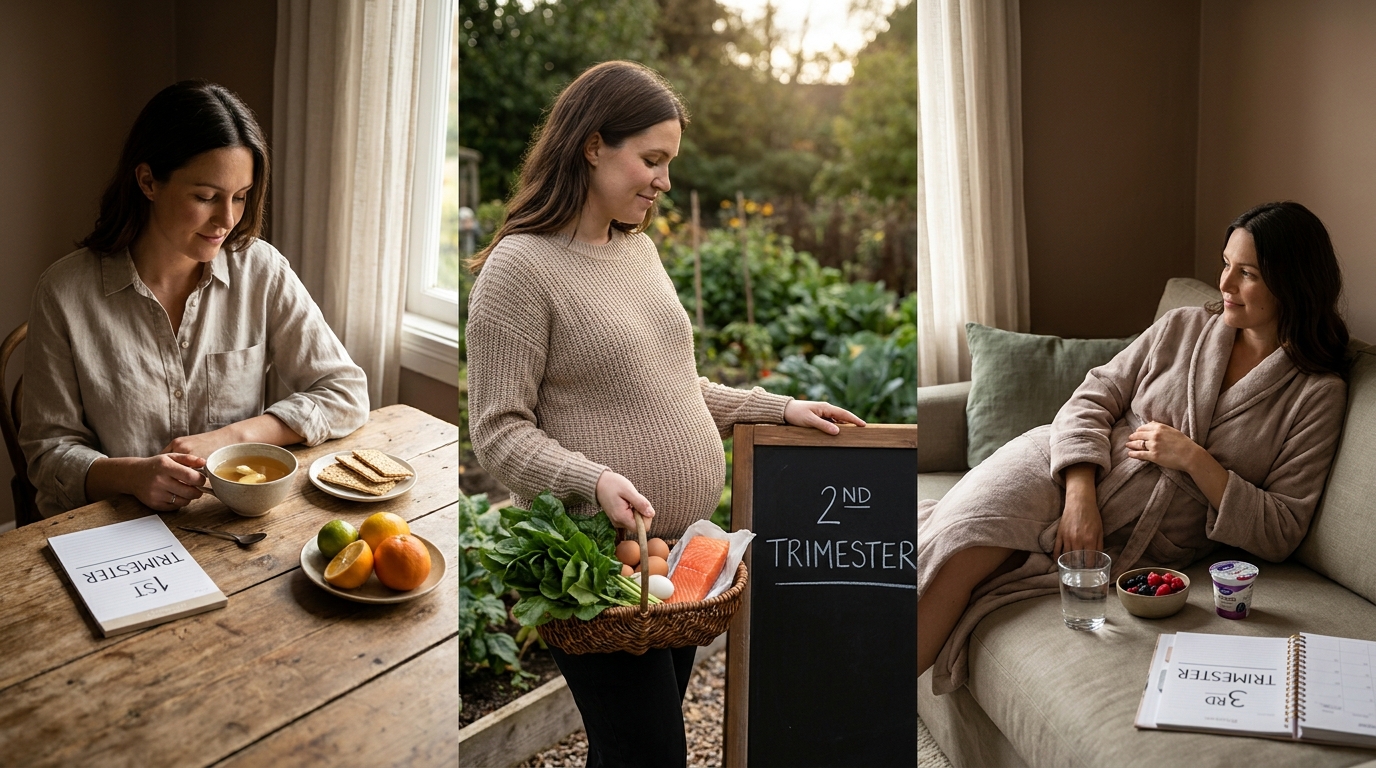
The biggest change is calories, and it arrives later than most people expect. ACOG guidance says the first trimester needs no extra calories, the second adds roughly 340 a day, and the third about 450 a day. The NHS frames it differently — it advises no extra calories until the last trimester, and then only around 200 more. That US–UK gap is real, so I've laid both out below.
Practically: trimester one is about surviving nausea and protecting folic acid; trimester two is when appetite returns and iron and calcium demand climbs; trimester three is steady energy plus fiber, since NHS notes constipation is common late on. My third-trimester nutrition guide goes deeper on the home stretch.
| Trimester | Extra calories (ACOG) | Extra calories (NHS) | Diet focus | Watch for |
|---|---|---|---|---|
| First (wk 1–13) | 0/day | 0/day | Folic acid, gentle foods | Nausea, food aversions |
| Second (wk 14–27) | ~340/day | 0/day | Iron, calcium, protein | Appetite rebound |
| Third (wk 28–40) | ~450/day | ~200/day | Fiber, steady energy | Constipation, heartburn |
Whatever the calorie number, the shape of the plate barely changes — steady, sensible eating tracks with the ranges in ACOG's weight-gain guidance, which I unpack in healthy pregnancy weight gain.
What does a full day of pregnancy eating actually look like?
Here's one real day that hits the food groups above and lands near the second-trimester targets: oats with fruit and milk, a lentil-and-spinach lunch, a salmon-and-veg dinner, plus two snacks — roughly 3 dairy servings, 5 veg-and-fruit portions, and a protein at every meal, in line with NHS balanced-plate guidance. Adjust portions up in the third trimester per the calorie table above.
- Breakfast: Porridge (3 tbsp oats) with milk, sliced banana, a spoon of peanut butter — carbs, ~300mg calcium, folate.
- Snack: A pear and a small handful of almonds — fiber plus a little iron and healthy fat.
- Lunch: Lentil and spinach soup (~150g lentils) with a wholegrain roll — a solid iron-and-fiber anchor.
- Snack: A pot of yogurt with berries — another ~200–300mg calcium toward the day's ~1000mg (NIH).
- Dinner: Baked salmon (140g) with roasted veg and brown rice — one of your 1–2 weekly oily-fish servings (NHS).
On my worst weeks this day was a fantasy and dinner was toast. That's fine — USDA's FoodData Central is what I used to swap sardines-on-toast in for salmon when standing at the hob felt impossible.
How do I adjust for nausea, gestational diabetes, or a plant-based diet?
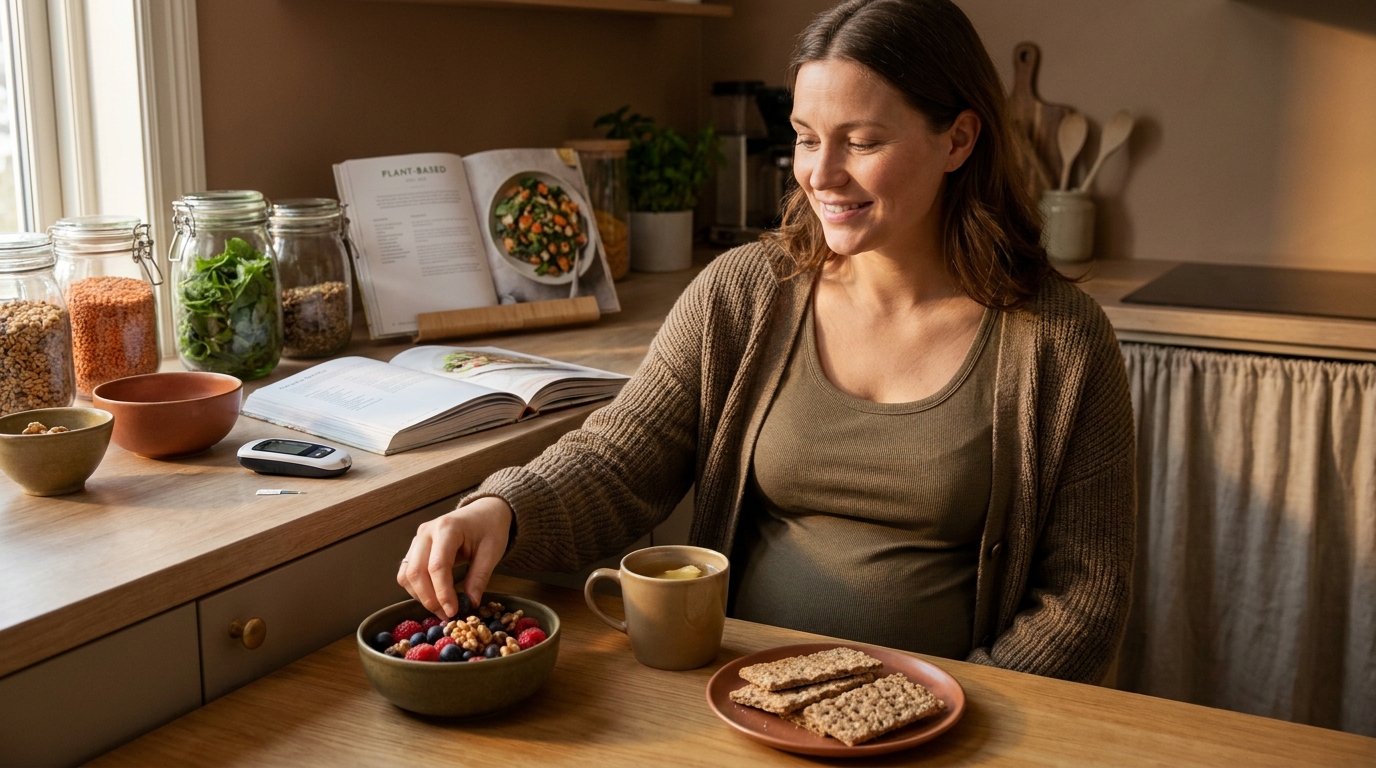
The plan bends without breaking. For nausea, NHS advises small frequent meals and plain starchy foods rather than forcing big plates. For gestational diabetes, NICE guideline NG3 emphasizes lower-glycemic carbs and portion control alongside your care team. For vegetarian and vegan eating, ACOG notes it's compatible with pregnancy when iron, B12, and DHA are covered. Specifics for each are below.
- Nausea: Dry crackers before you stand up, ginger, and cold foods that smell less. Around week 8, by 2pm I'd managed half a cold decaf and a single cracker — and NHS says that pass-the-day approach is genuinely okay early on.
- Gestational diabetes: Pair carbs with protein, favor whole grains, and follow the monitoring plan from your team, as NICE NG3 outlines. Don't self-manage this one solo.
- Vegan / vegetarian: Lean on lentils, tofu, fortified cereals for iron; a B12 source is non-negotiable; and an algae-based DHA covers the omega-3 that oily fish would.
- Caffeine, across all of the above: EFSA sets the caffeine limit at 200mg a day in pregnancy — about two mugs of instant coffee. That decaf habit started here.
Frequently Asked Questions
How many extra calories do I really need during pregnancy?
It depends on trimester and whose guidance you follow. ACOG points to roughly 340 extra calories a day in the second trimester and about 450 in the third, with none needed in the first. The NHS is more conservative, advising extra calories only in the last trimester and only around 200. Either way, the first trimester needs no calorie bump — a relief when nausea has you eating less anyway.
How much folic acid should I take and for how long?
NHS advises 400 micrograms of folic acid daily, ideally from before conception through the end of week 12, when the neural tube forms. Some people are advised a higher amount for specific medical reasons — that's a conversation for your own clinician, not a general rule. Food folate from leafy greens and fortified cereal is a helpful addition, but the supplement is the part guidelines treat as essential.
Is it safe to follow a vegan diet while pregnant?
Yes, with planning. ACOG notes vegetarian and vegan diets support a healthy pregnancy as long as iron, vitamin B12, and omega-3 DHA are deliberately covered — B12 in particular, since plants don't reliably provide it. Fortified foods, lentils and tofu for iron, and an algae-based DHA fill the usual gaps. A prenatal helps backstop the rest.
How much caffeine is okay in a pregnancy diet?
EFSA sets the pregnancy caffeine limit at 200mg a day, which is roughly two mugs of instant coffee or one strong brewed cup plus some tea. Remember caffeine hides in tea, cola, chocolate, and energy drinks too, so it adds up faster than the coffee count suggests. Staying under 200mg is the number to anchor to across US, UK, and EU guidance.
Do I need a prenatal vitamin if I eat well?
Most guidance says yes. Even a strong diet struggles to reliably hit the folic acid and, later, iron targets that pregnancy demands, which is why NHS and ACOG both recommend a daily supplement rather than relying on food alone. Think of it as a floor under a good diet, not a replacement for one — the food still carries the fiber, protein, and variety a pill can't.