Quick Answer: What Should I Eat in the First Trimester?
In weeks 1-13, ACOG notes your calorie needs barely change — early pregnancy is about food quality, not eating for two. Lock in 400 micrograms of folic acid daily (the amount the CDC advises before and through early pregnancy), then build meals around iron, vitamin B6, vitamin D, and choline. When nausea hits, eat whatever stays down. The full nutrient table, food lists, and a real sample day are below.
I was 6 weeks along the first time I realized "eat healthy" and "can only face dry toast at 2pm" were going to be at war for a while. So this guide holds both at once.
Which 5 Nutrients Matter Most in Weeks 1-13?
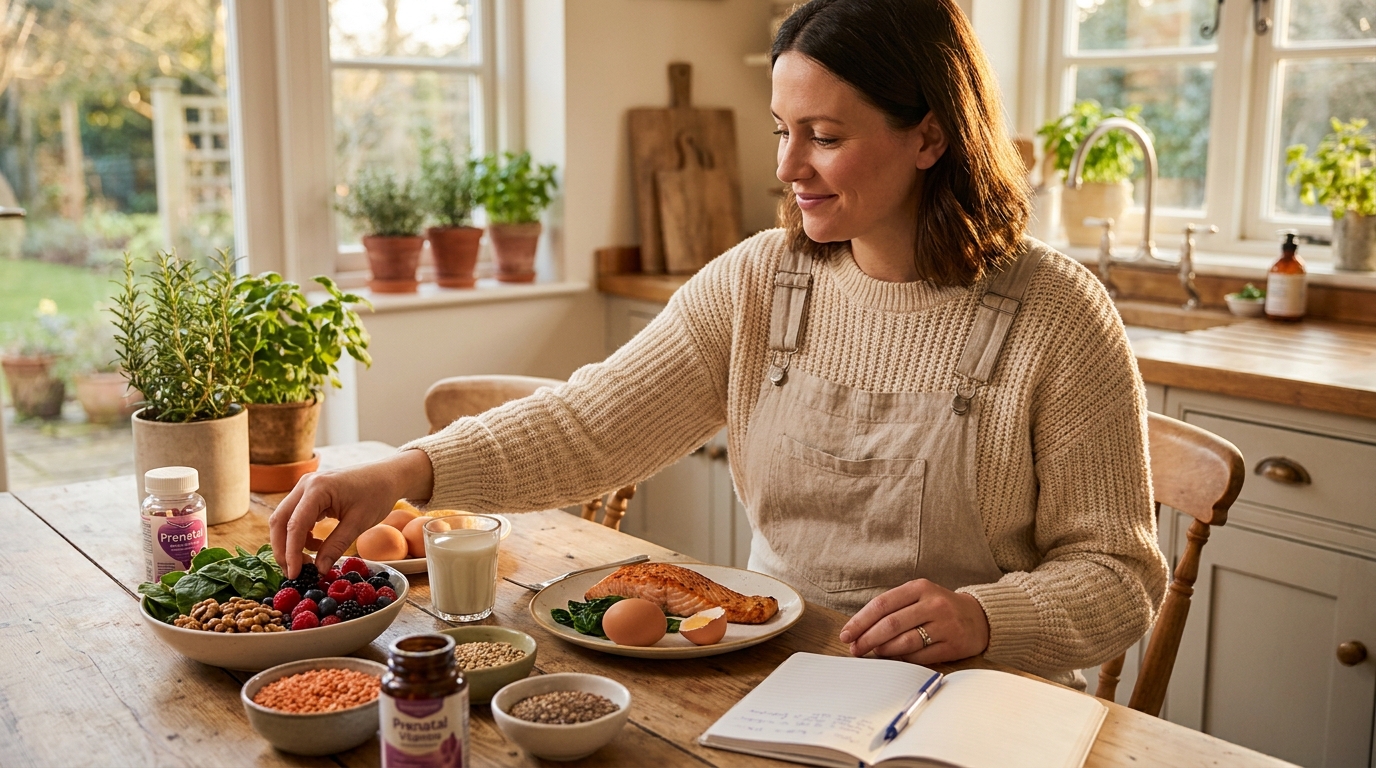
The five that do the heaviest lifting early on are folate, iron, vitamin B6, vitamin D, and choline. The CDC recommends 400 micrograms of folic acid every day because the neural tube closes by around week 6 — often before a positive test. The rest support your expanding blood supply, your baby's brain, and, in B6's case, your churning stomach.
Here's what each target actually looks like, with the authority behind it and the easiest way to hit it:
| Nutrient | Daily target (pregnancy) | Named source | Why it matters in weeks 1-13 | One easy food hit |
|---|---|---|---|---|
| Folate / folic acid | 400 mcg supplement + food folate | CDC | Neural tube closes ~week 6 | 1 cup cooked lentils (~360 mcg folate, USDA) |
| Iron | 27 mg | NIH ODS | Blood volume rises early | 1 cup cooked spinach (~6.4 mg, USDA) |
| Vitamin B6 | 1.9 mg | NIH ODS | Eases nausea; ACOG cites it first-line | 1 medium banana (~0.4 mg, USDA) |
| Vitamin D | 10 mcg | NHS | Bone and immune development | 1 fortified cereal bowl (~2.5 mcg, USDA) |
| Choline | 450 mg | NIH ODS | Baby's brain and memory wiring | 1 large egg (~147 mg choline, USDA) |
You don't have to hit every line perfectly on a nauseous day — that's what your prenatal and the rest of the week are for. Speaking of folate, if you want the deep food list, my folate-rich foods guide breaks down exactly which greens and legumes stack up.
What Are the Best First Trimester Foods by Nutrient?
The most efficient early-pregnancy foods double up: eggs deliver choline and B6, lentils bring folate and iron, and fortified breakfast cereals cover folic acid and vitamin D in one bowl. The NIH Office of Dietary Supplements lists eggs, legumes, and leafy greens among the densest sources for the nutrients that matter most before week 13.
A quick map so you can shop without a spreadsheet:
- Folate: lentils, chickpeas, spinach, asparagus, and fortified cereals — USDA data puts a single cup of cooked lentils near 360 mcg of food folate.
- Iron: lean red meat, tofu, beans, and fortified oats; pair them with vitamin C (a squeeze of orange) since the NIH notes vitamin C boosts non-heme iron absorption.
- Vitamin B6: bananas, potatoes, chicken, and chickpeas — the nutrient ACOG flags for early-pregnancy nausea relief.
- Choline: whole eggs are the standout; the NIH lists one large egg at roughly 147 mg, about a third of the daily 450 mg.
- Vitamin D: oily fish, fortified milk, and the daily 10 microgram supplement the NHS recommends for all pregnant women.
In week 9, scrambled eggs on toast was genuinely the only warm meal I could face — I clung to the fact that it was quietly covering my choline while everything else on the plate got pushed away.
What Foods Help With First Trimester Nausea?

For nausea, ACOG points to vitamin B6-rich foods and small, frequent carb-based snacks as a sensible first step, alongside ginger, which the NHS lists as a self-help measure that helps some people. Dry, bland, room-temperature foods tend to win because strong smells are half the battle — NHS estimates nausea affects the majority of pregnancies, usually easing by around weeks 16-20.
What actually helped me between weeks 7 and 11:
- Plain crackers or dry cereal before sitting up in the morning — an empty stomach was my worst enemy.
- Cold or room-temperature food, which barely smells (think yogurt, fruit, a cheese sandwich) over anything hot and fragrant.
- Ginger tea or ginger biscuits, the NHS-listed option that took the edge off my afternoon slump.
- Sipping fluids between meals rather than with them, so my stomach never felt too full.
If aversions have wrecked your usual meals, my nausea-friendly meal ideas are built entirely around bland, low-smell food that still carries real nutrients.
What Does a Simple Day of First Trimester Meals Look Like?
A realistic first-trimester day leans on small, frequent, nutrient-dense meals rather than three big ones — ACOG notes eating little and often helps steady both blood sugar and nausea. The plan below quietly covers folate, iron, B6, and choline across the day, so no single meal has to carry everything.
- Before you get up: a few plain crackers on the nightstand.
- Breakfast: fortified cereal with milk and a sliced banana — folic acid, vitamin D, and B6 in one bowl.
- Mid-morning: a small handful of almonds and an orange (iron helper via vitamin C).
- Lunch: a cheese-and-egg sandwich, cold if hot food turns your stomach — choline and protein.
- Afternoon: yogurt with berries, or ginger tea and a biscuit on a rough day.
- Dinner: lentil soup or a small bowl of dal with rice — a genuine folate and iron hit.
On my worst weeks this collapsed into "cereal three times a day," and that's honestly fine for a stretch. Once appetite returns, the second-trimester eating guide picks up where this leaves off.
What Foods Should I Avoid in the First Trimester?
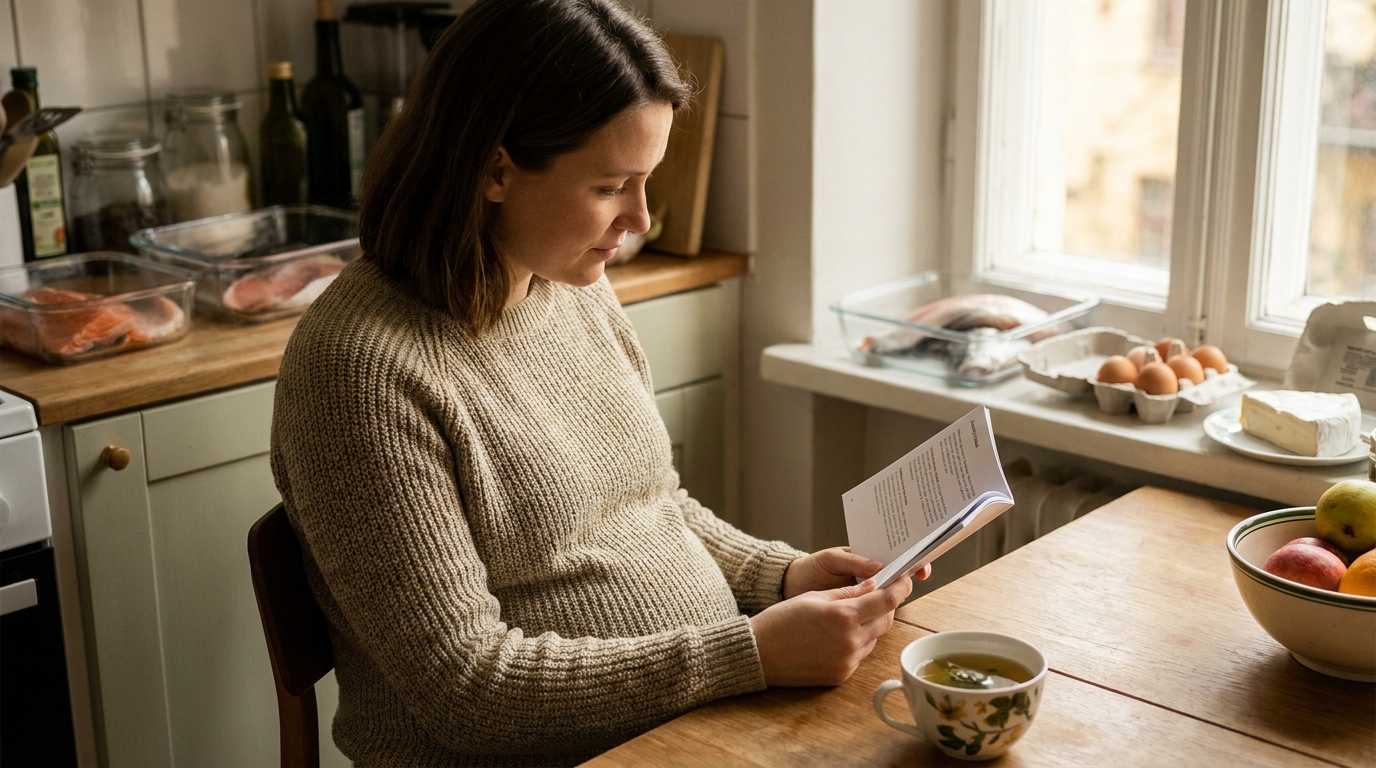
The NHS advises avoiding a specific short list from day one: raw or undercooked meat, unpasteurized and certain mould-ripened soft cheeses, high-mercury fish, raw shellfish, and pâté, plus a daily caffeine cap. Caffeine is the one with a hard number — the NHS sets the limit at 200mg per day, roughly two mugs of instant coffee.
| Food | Verdict | Why (limit / risk) | Source |
|---|---|---|---|
| Caffeine (coffee, tea, cola) | Limit | Cap at 200 mg/day (~2 mugs instant coffee) | NHS |
| Unpasteurized & mould-ripened soft cheese | Avoid | Listeria risk from unpasteurized dairy | NHS |
| Raw / undercooked meat & pâté | Avoid | Toxoplasma and listeria risk | NHS |
| High-mercury fish (shark, swordfish, marlin) | Avoid | Mercury affects developing nervous system | NHS |
| Oily fish (salmon, mackerel) | Limit | No more than 2 portions per week | NHS |
| Raw shellfish | Avoid | Food-poisoning risk from raw | NHS |
US and UK guidance mostly agree here, with one wrinkle: the FDA and EFSA also flag high-mercury fish, while EFSA has separately reviewed caffeine and considers up to 200mg per day compatible with pregnancy — the same ceiling the NHS uses, so the number travels across the Atlantic.
Frequently Asked Questions
What should I eat in the first trimester?
Focus on folate, iron, vitamin B6, vitamin D, and choline rather than eating more overall — ACOG notes calorie needs barely rise this early. Practically, that means fortified cereal, eggs, lentils, leafy greens, bananas, and dairy, spread across small frequent meals. Keep taking a prenatal with 400 micrograms of folic acid, the amount the CDC advises through early pregnancy.
What foods help with first trimester nausea?
Bland, dry, cool foods work best because strong smells trigger nausea. ACOG points to vitamin B6-rich foods like bananas and potatoes, plus small carb snacks, and the NHS lists ginger as a self-help option. Eating something before you get out of bed and sipping fluids between meals both help keep an empty or over-full stomach from setting you off.
Which nutrients matter most in early pregnancy?
Folate leads, because the neural tube closes around week 6 — the CDC recommends 400 micrograms of folic acid daily. Iron (27 mg per the NIH) supports rising blood volume, choline (450 mg) helps brain development, and vitamin D (10 micrograms per the NHS) supports bones. Vitamin B6 earns a spot both for development and for easing nausea.
What foods should I avoid in the first trimester?
The NHS says to avoid unpasteurized and mould-ripened soft cheeses, raw or undercooked meat, pâté, high-mercury fish, and raw shellfish from the start. Caffeine is capped, not banned — keep it to 200mg a day, about two mugs of instant coffee, a limit EFSA also supports. When in doubt about a specific food, check the NHS pregnancy pages or ask your midwife.
How many extra calories do I need in the first trimester?
Essentially none. ACOG notes the extra energy of pregnancy kicks in later — roughly 340 additional calories a day in the second trimester — so weeks 1-13 call for no meaningful calorie increase. If nausea shrinks your appetite, prioritise nutrient-dense bites over volume and don't stress about hitting a bigger number this early.